You don’t need millions of podcast downloads, streams or views to make money from podcasting. You can build a commercially successful content business with a modest but attuned audience. Start by attracting an audience that’s relevant to what you eventually want to sell. Use your content to build expertise, trust, relationships and intellectual property, then turn those assets into revenue through products, events, subscriptions, licensing, partnerships and other commercial opportunities.
This year Forbes published its list of the world’s highest-paid podcasters.
My first reaction was ‘wow’.
Not because of the figures. Joe Rogan came first, earning an estimated $82 million, which is actually fairly moderate compared with some other Forbes rich lists.
It was the fact that Forbes now considers podcasting culturally and commercially significant enough to warrant this kind of list.
Podcasting has come a long way.
But as I read through the names and how they amassed their wealth, something else occurred to me.
Their wealth wasn’t related to the best production values or the most journalistically accurate podcast (ahem); it isn’t even a straightforward ranking of the biggest audiences, although there is some overlap.
Their wealth is related to their commercial ventures.
This deserves a closer look at how that money is being made. There are advertising deals, media companies, live tours, subscriptions, books, merchandise, licensing agreements, premium communities and, importantly, ownership of intellectual property.
Call it confirmation bias on my part if you like, but I see it as more evidence for something I’ve believed for a long time:
The content isn’t necessarily the financial asset. It’s what the content allows you to build.
I’ve seen versions of this throughout my career.
Even within public service, there are multiple avenues for generating revenue. While at the BBC, I learned a piece of content doesn’t necessarily have one commercial life.
BBC World Service and Studios licence and distribute programming around the world, sell ad spots in international markets and licence other intellectual property such as books, memorabilia, and even a CBeebies Land Hotel and theme park at Alton Towers.
Of course, all of this is considerably easier when you’re a national corporation with enormous reach and a high-profile brand.
That’s where I think I haven’t always done a good enough job of translating what I’ve learnt from large media organisations into something useful for an independent creator.
So here it goes…
Can you make money from podcasting without millions of listeners?
The short answer is, yes. Let’s look at Dr Rupy Aujla. A qualified GP, Rupy launched The Doctor’s Kitchen Podcast in November 2017.
Today, The Doctor’s Kitchen Podcast has an estimated 10,000 listeners per month. If he’d treated the podcast itself as the business, the obvious commercial model would have been straightforward: aim for a large number of downloads and sell more advertising.
Instead, let’s look at how he approached it.
There are multiple books. He launched a subscription app in January 2022. He makes television appearances and speaks at conferences. His partnerships have included Made In Cookware and Sainsbury’s.
More recently, Aujla participated in a £2 million funding round for children’s food company Lune & Wild. He’s also Chief Science Officer and a director at Exhale Healthy Coffee and advises other health businesses.
I’m not suggesting every one of those opportunities happened because somebody listened to his podcast. That’s far too simplistic. The podcast sits inside a much larger body of work built around a recognisable area of expertise: food, medicine, nutrition and health.
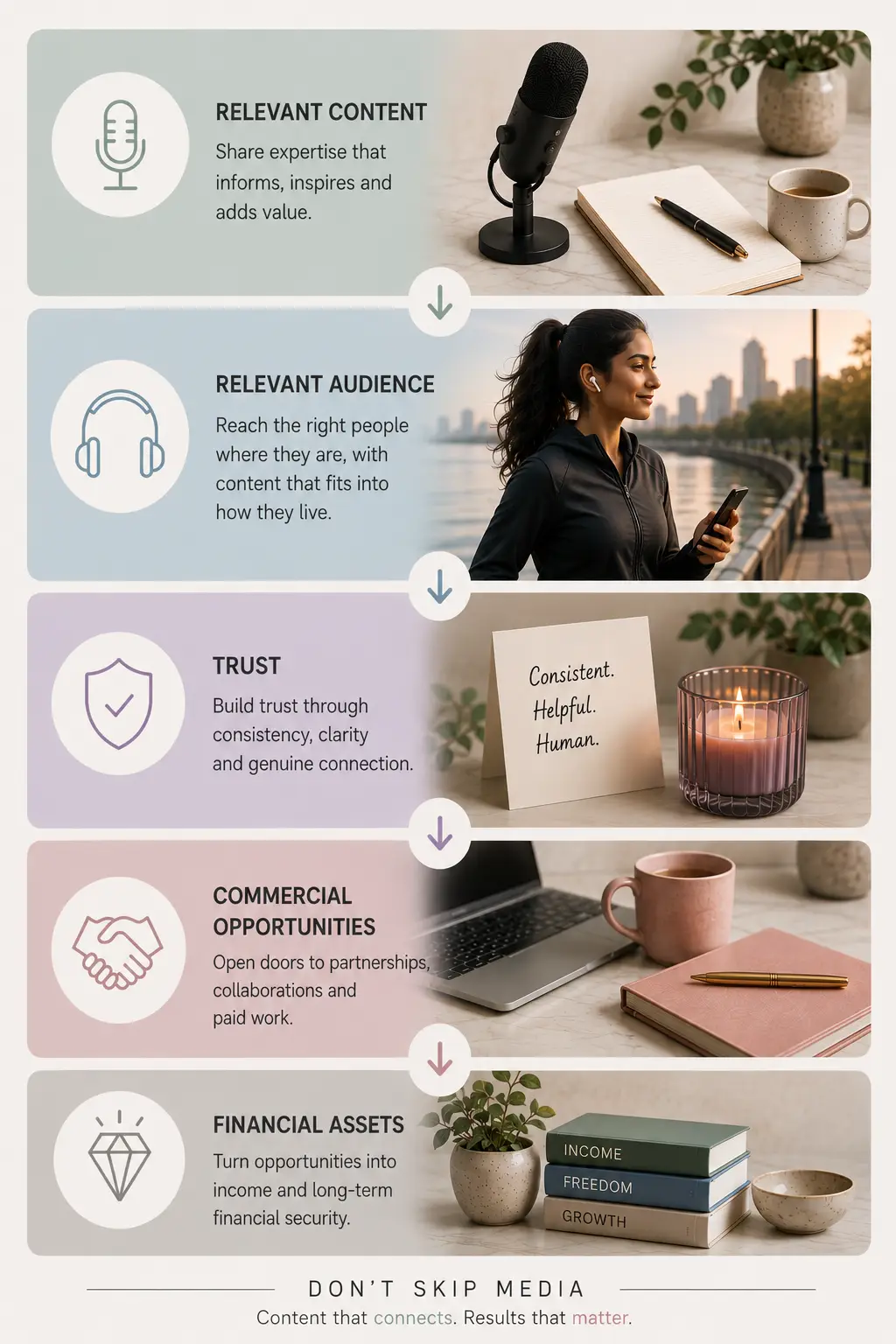
The content attracts people interested in that expertise.
Repeated visibility is working to build trust.
Trust is creating commercial opportunities.
And those opportunities can create income and financial assets.
I believe it’s a healthier way of thinking about how you make money from podcasting, and at Don’t Skip Media, we help our talent set themselves up for this kind of success.
Why doesn’t creating more content mean you’ll make more money from podcasting?
I see a lot of creators publishing content as a series of tasks.
Blog. Done.
Podcast episode. Published.
Instagram post. Check.
Video. Uploaded.
Then you move on to the next thing. It’s a spray-and-pray approach dressed up as a content calendar. And then creators wonder why doors aren’t opening.
The hamster-wheel approach creates activity, but there often isn’t a clear connection between who you’re attracting and how that attention could eventually become income.
So how should you approach it?
If 500 relevant people listen to your podcast every month, I’d be much more interested in who those 500 people are than whether you can somehow turn them into 5,000 random listeners. Dr Ayesha Taylor-Camara discusses understanding your audience in episode 13 of A Mind for Marketing.
CPMs encourage us to think that bigger automatically means more valuable. But it doesn’t.
Five hundred people who could buy from you, recommend you, commission your work, invite you onto a stage, licence your ideas or introduce you to somebody useful can be an extremely valuable audience.
But only if you’ve thought about what you’re building around their interests. It’s ‘content that connects’.
At Don’t Skip Media, this is why we don’t treat production and strategy as completely separate jobs. We help talent think about who they’re trying to attract, what they want to become known for and what commercial opportunities the content could eventually support.
What assets can a podcast help you build?
Some time ago I read Andy Bass’s Start with What Works. It’s written for business leaders, but one idea has stayed with me, which I recommend you heed.
You can’t always change the environment you’re operating in, but you can decide how well you use the resources you already have.
Your podcast is more than a collection of digital audio files. It:
- Can demonstrate your expertise.
- Can create relationships with interesting guests.
- Gives you audience data.
- Generates ideas that can become intellectual property.
- And, hopefully, it creates a growing group of people who trust what you have to say.
Those are YOUR resources.
So, what can you build from them?
Ideas for making money from podcasting?
- Start with owning your audience.
A podcast follower is valuable, but an email subscriber gives you a relationship that isn’t entirely dependent on somebody else’s platform.
2. Start small.
Run a live event. It doesn’t need to be Wembley. Five relevant people in a hired meeting room is better than the imaginary 500-person conference you never organise.
As your audience develops, think about:
Could a framework become an online cohort?
Could original research sit behind a paywall?
Could your expertise become a half-day workshop that helps people solve a specific problem?
Could it become a book people refer to repeatedly? Training? A useful product?
3. Think about recurring revenue.
Memberships, paid communities and subscriptions can give a business something advertising rarely provides: more predictable income.
4. Don’t overlook licensing.
Netflix and Prime aren’t the only buyers of intellectual property. Broadcasters, FAST channels, publishers, brands and platforms are all potential routes to making money from podcasting.
How do you build a podcast around a commercial goal?
I’d start by working backwards from the business you want.
Suppose you’d eventually like to publish a book.
Who needs to buy that book?
What do those people want to understand?
What problems are they trying to solve?
Where do they already spend their time?
What podcasts, YouTube channels, newsletters and creators already have their interest?
Then look at your content.
If you already have a podcast or YouTube channel, are you actually creating something those people would choose to consume?
What would need to change?
If you’re starting from scratch, don’t begin with microphones and episode artwork.
Begin with the audience, then move forward. The image below illustrates the flow to success:
That’s the foundation we help creators build at Don’t Skip Media. Not simply publishing more content, but making deliberate decisions about the audience, positioning and opportunities the content is supposed to create.
The people at the top of the Forbes list have built businesses around areas of interest, trust, relationships and intellectual property.
You don’t need 80 million downloads to start doing the same thing.